Directly upon entering, you are immersed in the giant installation Calyx by the British artist Rebecca Louise Law (1980). Consisting of over a hundred thousand dried flowers that have been strung together, the work is a multi-sensory space where you are invited to calm down and take some time for a moment of tranquillity and reflection.
(Super)natural beauty
In various religious traditions, flowers are seen as symbols of enlightenment, purity, and paradise, while in ancient Greek myths they represent divinity and transformation. Presented in the exhibition are objects and paintings that depict such myths, including the well-known story of Narcissus, a mythological figure who also lent his name to a famous yellow spring flower.
Science
Botanical drawings and herbariums from the 18th and 19th centuries illustrate the intimate link between art and science. The contemporary work Of Palimpsests and Erasure by the Dutch artist patricia kaersenhout (1966) reveals hidden layers of knowledge and history. In large, colourful tapestries kaersenhout explores how we view, preserve and pass on nature and heritage. With this work, the artist responds to the botanical book Metamorphosis insectorum surinamensium (1705) by Maria Sibylla Merian, which is also shown in the exhibition. While Merian’s detailed drawings of the insects, flowers, and plants of Suriname made her world-famous, a lesser-known fact is that she got most of her knowledge from enslaved Indigenous and African women.
Valuable commodities
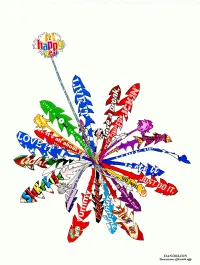
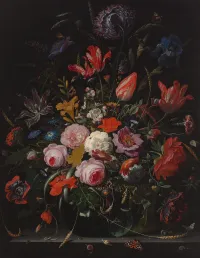
Flowers Forever furthermore zooms in on how flowers became increasingly important in Western art, most notably in 17th-century still lifes where they symbolise wealth and status. In the 17th century, tulip mania in the Netherlands meant that, for the first time, the trade in flowers became a large-scale speculative business. In her video installation Mosaic Virus (2019) , the British artist Anna Ridler (1985) visualises stock market fluctuations in a surprising way, with three screens showing time-lapse sequences of how the growth of a tulip is influenced by fluctuations in the Bitcoin market. While flowers are all around us, the British artist Tracey Bush (1964) shows that most of us are more likely to recognise an advertising message than a specific type of flower. For her colourful collages she shapes the contours of dandelions, daisies, or poppies out of discarded packaging of well-known products.
Politically charged
Flowers can also represent change or protest and are frequently used in aristocratic coats of arms or as national symbols. The exhibition features various cartoons and political posters. The Canadian artist Kapwani Kiwanga (1978) also uses flowers to discuss social issues. Her work The Marias consists of two paper reproductions of the peacock flower. Used as a means to terminate unwanted pregnancies, enslaved African women would conceal the seeds of this plant in their hair. The work poignantly visualises how, during the same period, Victorian women would fold paper flowers as an innocent pastime, while others were forced to use flower seeds as a last means of survival and act of resistance.
Technology
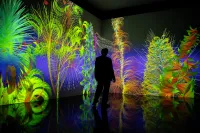
A work by Studio DRIFT is also part of the exhibition. Meadow is an upside-down landscape that is a kinetic sculpture consisting of mechanical flowers that open and close in a poetic choreography. The installation suggests the impermanence of the ever-changing seasons and the sensational character of natural growth processes. Meadow is the result of DRIFT’s examination into how an inanimate object can mimic those changes that express character and emotions. With his interactive installation Extra Natural, the French artist Miguel Chevalier (1959) invites you to enter a virtual garden where various seeds and flowers have been digitally brought to life. His colourful creations move along when you walk through the immersive space.
Collaboration
The exhibition Flowers Forever was initiated by Kunsthalle München in collaboration with Kunsthal Rotterdam.
Publication
The exhibition Flowers Forever will be accompanied by the Dutch-language catalogue Flowers Forever. Bloemen in Kunst en Cultuur. This book will be available from the Kunsthal Shop and Kunsthal Webshop from 27 March.
Partners
Exhibition partners

About your visit
Frequently Asked Questions
Skip listThe Kunsthal is open from Tuesday to Sunday, from 10:00 to 17:00 hrs. The Kunsthal Café opens half an hour earlier, so you can visit from 9:30 hrs until half an hour after closing time. Check the current opening hours.
Yes, you need to book a ticket with a start time in advance. This also applies if you have a Museum card, Rotterdam pass, or VriendenLoterij VIP Card. This way, you are guaranteed admission and we can ensure that your visit is as pleasant as possible. Book your start time.
Yes, with an online ticket, you can visit all the exhibitions that are on display on the date of your visit. You can also stay as long as you like. You are welcome at the Kunsthal from your designated start time until closing time. Book your start time.
In de Kunsthal Rotterdam zijn altijd meerdere wisselende en contrastrijke tentoonstellingen tegelijk te zien. Een volledig overzicht van alle actuele tentoonstellingen vind je op de tentoonstellingspagina.