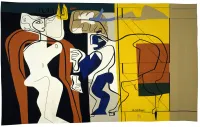
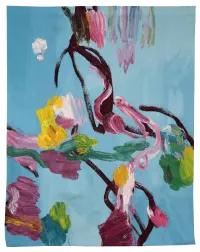
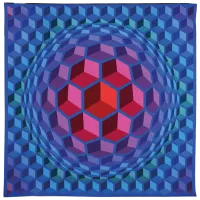
In ten chapters, ‘Extra Large’ will show the development of the tapestry. The colourful, figurative and occasionally very abstract works reveal the endless possibilities of the craft. The brightly coloured ‘Une carte du Japon’ – made between 2012 and 2017 after a design by the French artist Alain Séchas – shows how weavers are able to imitate the expressive brushstrokes used in painting. Also surprising are the handcrafted optical illusions of Victor Vasarely and the Israeli artist Yaacov Agam. Their often square-shaped tapestries look as if they are three-dimensional and almost appear to be moving. Since the beginning of this century, technical aspects of the digital age also started to make an appearance in the designs. With a computer-manipulated self-portrait, the French artist ORLAN is for instance challenging conventional ideals of beauty. And with extremely enlarged pixels in his work ‘Jardins des Gobelins’, Christophe Cuzin, another French artist, emphasises the similarities between digital imaging techniques and the woven grid structure of the tapestry.
Intensive manual labour
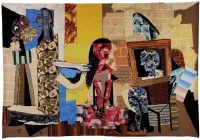
Already since the beginning of the seventeenth century, the French State has been commissioning renowned artists to design tapestries that are subsequently produced in the national weaving workshops. The designs sometimes convey a sociopolitical message or depict historical revolutions, while other tapestries have a more decorative purpose. Although the old techniques for weaving and knotting have remained unchanged, the often complex designs of the tapestries have resulted in innovating the craft. Picasso’s design ‘Les Femmes à leur toilette’, for instance, remained on the shelf for thirty years until, in 1971, the weavers were finally experienced and confident enough to start working on the particularly detailed tapestry. The realisation of this tapestry took no less than six years. Even now, the completion of a unique tapestry often requires years of intensive manual labour.
Monumental
For the exhibition ‘Extra Large’, the Louvre Museum in Paris is taking the tapestry ‘La Globe terrestre’, which is only finished for one third, out of storage for the first time. In 1940, the German painter Werner Peiner was commissioned by the German occupying force to make this 72 m2 design. After the liberation in 1944, the production of the monumental tapestry was abruptly halted. In 1943, the French artist Jean Lurçat had responded with his design for the gold-coloured tapestry ‘Liberté’, expressing the French people’s desire for freedom. This work is also shown at the Kunsthal.
Partners
Exhibition partners

About your visit
Frequently Asked Questions
Skip listThe Kunsthal is open from Tuesday to Sunday, from 10:00 to 17:00 hrs. The Kunsthal Café opens half an hour earlier, so you can visit from 9:30 hrs until half an hour after closing time. Check the current opening hours.
Yes, you need to book a ticket with a start time in advance. This also applies if you have a Museum card, Rotterdam pass, or VriendenLoterij VIP Card. This way, you are guaranteed admission and we can ensure that your visit is as pleasant as possible. Book your start time.
Yes, with an online ticket, you can visit all the exhibitions that are on display on the date of your visit. You can also stay as long as you like. You are welcome at the Kunsthal from your designated start time until closing time. Book your start time.
In de Kunsthal Rotterdam zijn altijd meerdere wisselende en contrastrijke tentoonstellingen tegelijk te zien. Een volledig overzicht van alle actuele tentoonstellingen vind je op de tentoonstellingspagina.