Industrialization
The Industrialization set in relatively late in the Netherlands. It was only from 1860 onwards that industrialization and urbanization started to leave their marks on the Dutch landscape. Kilometers of train rails were constructed. The digging of channels and building of railroad bridges opened up various areas. The big infrastructural works altered the typically Dutch landscape with its desolate fields, vacant polders and low horizons. Instead of all this, a modern landscape, with steam driven pumping stations, broad and straight rivers and a web of railways and telegraph poles, emerged.
Painting
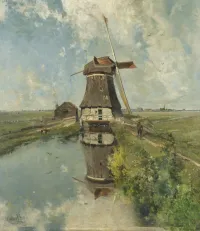
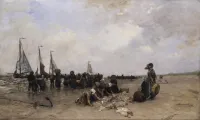
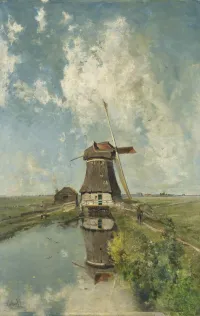
Following the French School of Barbizon painters belonging to The Hague School, amongst whom Willem Roelofs, Anton Mauve, the Maris brothers and Johan Weissenbruch went outside in order to capture the Dutch landscape on canvas. As subject of their paintings they chose places where the rise of industry and cities was still visible. In a realistic manner and with great sense of use of light and atmosphere they painted the dunes, the sea and polders.
Photography
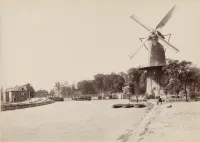
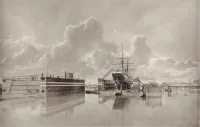
Not only painters belonging to The Hague School, but also photographers showed a keen interest in the alterations of the landscape. Commissioned by the engineers at Rijkswaterstaat a small group of photographers, amongst whom Pieter Oosterhuis and Henri de Louw, documented the examples of the constructional tour de force that emerged in the landscape. The business like photo series which they made clearly show how the Dutch landscape was permanently and radically changed by the end of the nineteenth century.
Publication
Hatje Cantz published the German catalogue ‘Der Weite Blick, Landschaften der Haager Schule aus dem Rijksmuseum' ISBN 978-7757-2270-4 (hardcover: € 45,- / softcover: € 39,50).The bookshop also sells the Dutch publication 'Spiegel van Holland, Het mooiste van de Haagse School in het Rijksmuseum' (€ 19,90).
In collaboration with
Neue Pinakothek
Rijksmuseum Amsterdam
Thanks to
Bankgiro Loterij
VSB Fonds
About your visit
Frequently Asked Questions
Skip listThe Kunsthal is open from Tuesday to Sunday, from 10:00 to 17:00 hrs. The Kunsthal Café opens half an hour earlier, so you can visit from 9:30 hrs until half an hour after closing time. Check the current opening hours.
Yes, you need to book a ticket with a start time in advance. This also applies if you have a Museum card, Rotterdam pass, or VriendenLoterij VIP Card. This way, you are guaranteed admission and we can ensure that your visit is as pleasant as possible. Book your start time.
Yes, with an online ticket, you can visit all the exhibitions that are on display on the date of your visit. You can also stay as long as you like. You are welcome at the Kunsthal from your designated start time until closing time. Book your start time.
In de Kunsthal Rotterdam zijn altijd meerdere wisselende en contrastrijke tentoonstellingen tegelijk te zien. Een volledig overzicht van alle actuele tentoonstellingen vind je op de tentoonstellingspagina.