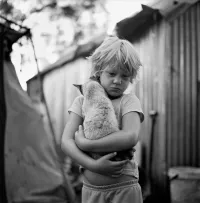
For her photo series ‘A Journey to the Homeland’, Katharine Cooper used her Hasselblad camera to photograph the white farmers, with a special focus on their children, who got caught up in political and economic forces beyond their comprehension. More than thirty-five analogue black and white photographs not only show poverty and vulnerability, but also reveal a certain amount of pride and love for the continent where Cooper grew up. Pride and joy are tempered by vulnerability, while a smile accompanied by a riffle hides the uncertainty. The presence of animals in the photographs adds a deeper layer of meaning. A little boy clumsily holding a kitten, and therefore experiencing some kind of love, or a young man assuming the same huddled-up and defenceless position as the bunny in his lap.
Cooper plays with light, geometry, texture and intensity, and excels in the space between the personification of the families and the way in which they are portrayed. The analogue images seems to have been framed in their square formats. These silver gelatine prints give the impression that the photographs were made decades ago, while the black and white also refers to the journalistic character of the subject. Although she consciously decided to focus on one of the many minorities in South Africa – a minority she once belonged to herself –, this should not be perceived as either a victory over or an apology for the colonial past.
Katharine Cooper
In 2004, Katharine Cooper graduated from the ‘École Nationale Supérieure de la Photographie’ in Arles, France, after which she worked in the studio of the renowned photographer Lucien Clergue. She developed into a socially committed documentary photographer and now travels all over the world. In 2013, Cooper returned to Africa for a four-month journey through Zimbabwe and South Africa. This journey resulted in the photographic series ‘White Africans: A Journey to the Homeland’ for which Cooper received the 2013 photography award of the Académie des Beaux-arts in Paris. Cooper is also interested in the problems of the Middle East and, since 2015, has made several journeys to war zones in Syria and Iraq. In these places she also photographs families that are struck by fate.
Partners
Exhibition partners

About your visit
Frequently Asked Questions
Skip listThe Kunsthal is open from Tuesday to Sunday, from 10:00 to 17:00 hrs. The Kunsthal Café opens half an hour earlier, so you can visit from 9:30 hrs until half an hour after closing time. Check the current opening hours.
Yes, you need to book a ticket with a start time in advance. This also applies if you have a Museum card, Rotterdam pass, or VriendenLoterij VIP Card. This way, you are guaranteed admission and we can ensure that your visit is as pleasant as possible. Book your start time.
Yes, with an online ticket, you can visit all the exhibitions that are on display on the date of your visit. You can also stay as long as you like. You are welcome at the Kunsthal from your designated start time until closing time. Book your start time.
In de Kunsthal Rotterdam zijn altijd meerdere wisselende en contrastrijke tentoonstellingen tegelijk te zien. Een volledig overzicht van alle actuele tentoonstellingen vind je op de tentoonstellingspagina.