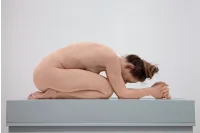
With 35 artworks by 28 artists, the Kunsthal will present - for the first time in the Netherlands - an overview of the worldwide developments in hyperrealist sculpture over the past fifty years. In the 1960s and 1970s a number of sculptors, each from their own perspective, became interested in a type of figurative art based on representations of the human figure that were as vivid and lifelike as possible. Standing face to face with these works provokes a reaction from the visitors, raising questions about the extent to which human beings can be manipulated and about identity in general. How do we see ourselves and others? – An interesting topic in the light of the current selfie culture on social media.
Human replicas
In five different themes, the exhibition will show how our perspective on the human body is subject to constant change. ‘Doppelgangers’ zooms in on artists such as Duane Hanson and John DeAndrea who, in the 1960s, set the trend by making life-sized sculptures. To make the sculptures even more lifelike, they used extremely laborious, complex procedures and innovative materials to meticulously replicate the structure of the human skin, and combined the works with objects from reality. Also shown are the hyperrealist nudes of the American artist Paul McCarthy and works by the French artist Daniel Firman, who, by contrast, fully dresses his figures and systematically conceals their facial features and limbs.
Dimensions
From the 1990s a number of artists, including Ron Mueck, Marc Sijan and Sam Jinks, started to drastically enlarge or reduce the dimension of their figures. Ron Mueck uses this method to focus on the transitional stages of life, such as birth, old age and death. By depicting the human body in an alienating way, he makes these themes even more profound.
A spectacular example of this is the five meter long work ‘A Girl’ from 2006 (from the collection of the Scottish National Gallery of Modern Art), representing a new-born baby.
Deformed realities
The theme ‘deformations’ zooms in on artists such as Evan Penny and Patricia Piccinini who observe the body from distorted perspectives, Tony Matelli who, with his floating figure, seems to completely discard the laws of nature, and Berlinde de Bruyckere who explores themes like death and human existence with her sculptures of contorted bodies.
Body parts
The theme ‘body parts’ shows the works of artists who, since the 1990s, have focused their attention on specific parts of the body. Maurizio Cattelan’s disconnected arms and Robert Gober’s apparently cleanly severed lower part of a hairy leg projecting from the wall, as well as the life-sized heads by John Davies and the almost surrealist human parts by Peter Land, all convey disturbing messages, occasionally with a touch of humour.
About your visit
Frequently Asked Questions
Skip listThe Kunsthal is open from Tuesday to Sunday, from 10:00 to 17:00 hrs. The Kunsthal Café opens half an hour earlier, so you can visit from 9:30 hrs until half an hour after closing time. Check the current opening hours.
Yes, you need to book a ticket with a start time in advance. This also applies if you have a Museum card, Rotterdam pass, or VriendenLoterij VIP Card. This way, you are guaranteed admission and we can ensure that your visit is as pleasant as possible. Book your start time.
Yes, with an online ticket, you can visit all the exhibitions that are on display on the date of your visit. You can also stay as long as you like. You are welcome at the Kunsthal from your designated start time until closing time. Book your start time.
In de Kunsthal Rotterdam zijn altijd meerdere wisselende en contrastrijke tentoonstellingen tegelijk te zien. Een volledig overzicht van alle actuele tentoonstellingen vind je op de tentoonstellingspagina.