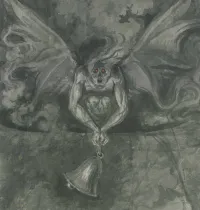
Divided into seven themes, the exhibition shows that certain convictions and fears are of all times. The theme ‘Death comes for us all’ deals with the inevitable human demise and the prominent role death plays in art history. So-called Dances of Death, in which skeletons accompany people in a dance to the grave, are masterfully brought to life in the wood carvings of Hans Holbein II (1497-1543). Typical of depictions of this theme is that death comes for everyone and does not discriminate between rich or poor, sinner or saint.
Biblical hellscapes
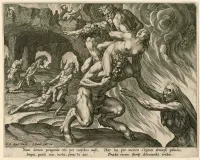
Religious depictions of Judgement Day, the Apocalypse, and hell are brought together under the title ‘Biblical hellscapes’. These works played a crucial role in the propagation and reinforcement of the Christian faith, especially at a time when many people were still unable to read. In ‘Devils and Monstrosities’, visitors are confronted with the many guises of Satan, as portrayed in prints by artists like Albrecht Dürer (1471-1528), and David Humbert de Superville (1770-1849). Either depicted as a beast with horns, or seductive and mysterious, but always embodying evil.
Surrealistic and supernatural
The theme ‘Nightmares and Visions’ focuses on dreamlike and surreal depictions of the subconscious: from a fight between a jug with legs and a little headless man on a barrel in the water, to horrific plagues and monstrous figures. The fact that artists found inspiration in the collective fear and fascination for the supernatural can be explored in ‘Magic and Witchcraft’. Brooms, revolting potions, and mystical rituals are featured in the prints of artists like Pieter Bruegel the Elder (ca. 1525-1569), and Hans Baldung Grien (ca. 1484-1545).
Humorous elements
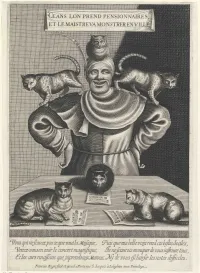
Despite their dark connotations, many of the works also contain humorous elements, resulting in an interesting paradox. ‘Everyday life at its strangest’ offers a platform to quacks, satirical depictions, and – occasionally humorous – legends. And finally, the works combined under the title ‘Allegorical madness’ at first glance mainly appear to showcase bizarre scenes, but those who look closer might also draw some important lessons from them. A print featuring sheep going to a wolf for confession, for instance, can be interpreted as a complaint against ecclesiastical power, while fighting money bags and chests are symbolic for the hypocrisy of war. In the interactions between shadow and light, humour and seriousness, you can experience the nuances of human existence.
Leiden University Libraries
The exhibition is realised in close collaboration with the Leiden University Libraries (Universitaire Bibliotheken Leiden, UBL). UBL is responsible for a number of special collections of national and international importance, including manuscripts, drawings, books, archives, photographs, maps, and letters from all over the world. UBL has an active acquisition policy to supplement these collections, which are made available to educational institutions and researchers, as well as other interested parties.
About your visit
Frequently Asked Questions
Skip listThe Kunsthal is open from Tuesday to Sunday, from 10:00 to 17:00 hrs. The Kunsthal Café opens half an hour earlier, so you can visit from 9:30 hrs until half an hour after closing time. Check the current opening hours.
Yes, you need to book a ticket with a start time in advance. This also applies if you have a Museum card, Rotterdam pass, or VriendenLoterij VIP Card. This way, you are guaranteed admission and we can ensure that your visit is as pleasant as possible. Book your start time.
Yes, with an online ticket, you can visit all the exhibitions that are on display on the date of your visit. You can also stay as long as you like. You are welcome at the Kunsthal from your designated start time until closing time. Book your start time.
In de Kunsthal Rotterdam zijn altijd meerdere wisselende en contrastrijke tentoonstellingen tegelijk te zien. Een volledig overzicht van alle actuele tentoonstellingen vind je op de tentoonstellingspagina.