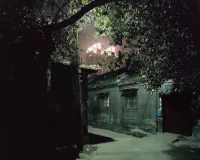
The streets and buildings that Tézenas takes photographs of can be considered as silent witnesses of the economic progress of a metropolis-to-be. His monumental photographs show the historical city of Beijing which contrasts strongly with the changes and alterations the city is undergoing at the moment. Narrow streets, called hutongs, ancient neighbourhoods and expropriated houses are pulled down at a good pace in order to make way for modern high-rise buildings, shopping centres, broad avenues and highways.
Beijing
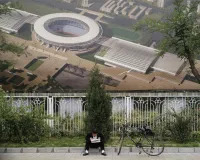
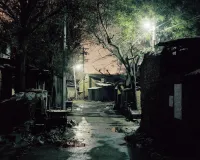
The Olympic Games in Beijing have greatly increased the pace at which the construction activities take place. Within a period of time of less than ten years an area the size of the city of Paris has been pulled down and has been built on all over again. Tézenas' work indicates the enormous transformation process currently taking place in China, where political decision-making sharply contrasts with the preservation of history and the needs of the local inhabitants. From the (nighttime) shots taken by Tézenas a surreal city emerges, between high-rise buildings blazing with light, hoisting cranes and debris, in which human beings can hardly be found anywhere. Only at the building sites, where work goes on both day and night, workmen are present. The tragedies that are undoubtedly evoked by the ever progressing, brute force of the construction industry can only be surmised.
Ambroise Tézenas
Ambroise Tézenas (Paris, 1972) finished his education at the École d'Arts Appliqués (EAA Photography) in Vevey, Switzerland in 1994. As a press photographer he produced reports of amongst others the confession of Catholic faith in France (1997), the rehabilitation of road victims (1998) and the retrocession of the Panama Canal (1999). From 2000 to 2002 he worked for an agency called Editing, publishing regularly in both the French and the international press.
Since 2002 Tézenas has aimed at more free assignments in the fields of stage-management and landscape.
Publication
Hutongs van Beijing, published by Mets & Schilt (ISBN 978 90 5330 527 0)
About your visit
Frequently Asked Questions
Skip listThe Kunsthal is open from Tuesday to Sunday, from 10:00 to 17:00 hrs. The Kunsthal Café opens half an hour earlier, so you can visit from 9:30 hrs until half an hour after closing time. Check the current opening hours.
Yes, you need to book a ticket with a start time in advance. This also applies if you have a Museum card, Rotterdam pass, or VriendenLoterij VIP Card. This way, you are guaranteed admission and we can ensure that your visit is as pleasant as possible. Book your start time.
Yes, with an online ticket, you can visit all the exhibitions that are on display on the date of your visit. You can also stay as long as you like. You are welcome at the Kunsthal from your designated start time until closing time. Book your start time.
In de Kunsthal Rotterdam zijn altijd meerdere wisselende en contrastrijke tentoonstellingen tegelijk te zien. Een volledig overzicht van alle actuele tentoonstellingen vind je op de tentoonstellingspagina.